
A child's drawing in a plain frame with a wide white mount looks like a real piece of art. It also makes the person who drew it very proud. The good news is that you do not need a framing shop. Standard frames and ready-made mounts do the job, and you only need to get three things right: the size, the mount and the glazing.
The short answer: measure your paper, buy a frame one size up with a mount, fix the drawing to the mount with acid-free tape at the top only, and hang it out of direct sunlight.
Why use a mount?
A mount (called a mat in the US) is the card border between the drawing and the frame. For children's art it does four useful things:
- It keeps the glass off the artwork. Thick crayon, paint and glitter stick to glass over time.
- It hides ragged edges, torn corners and the white margin a child left around the picture.
- It makes the picture look intentional. The same drawing looks more valuable with space around it.
- It lets standard frames fit odd papers. A mount can adjust the size of the picture to fit a frame you can buy anywhere.
How do you measure for a frame?
Frame sizes are the size of the thing the frame holds, not the outside of the frame itself. Always say width first, then height.
- Measure the drawing, edge to edge, in millimetres (or inches).
- Decide if you want a mount. For children's work, yes.
- Choose a mount opening about 10 millimetres (half an inch) smaller than the paper in each direction. That makes the mount overlap the drawing by about 5 millimetres (a quarter of an inch) on each side, so the edges are hidden and the drawing cannot slip out.
- Choose a frame the size of the mount, not the size of the picture.
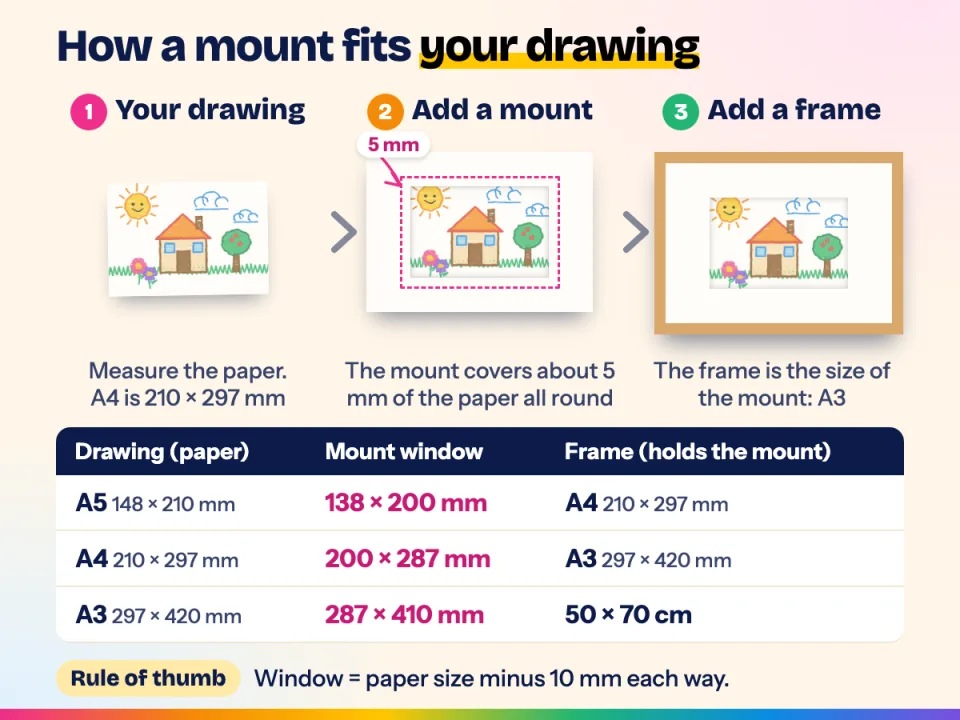
Framers vary on the overlap, from a few millimetres to a gap of half an inch if you want to show the paper's edge. Pick the look you like and stay consistent across a wall of frames.
Which frame size for which paper?
| Your drawing | A frame that fits, with a mount |
|---|---|
| A5 (148 x 210 mm) | A4 frame with a mount for A5 |
| A4 (210 x 297 mm) | A3 frame with a mount for A4 |
| A3 (297 x 420 mm) | 50 x 70 cm frame with a mount for A3 |
| US letter (8.5 x 11 in) | 11 x 14 in frame with a mount for 8.5 x 11 |
| 9 x 12 in school paper | 12 x 16 in frame with a mount for 9 x 12 |
Mounts for these pairings are sold ready-made. Look for "frame with mount for A4" and so on. If the paper is an odd size, a made-to-measure mount from a framer or an online shop is not expensive, or you can scan the drawing and print it at a standard size (see below).
Glass, acrylic and fading
- Glass is clear and scratch-resistant but heavy and breakable.
- Acrylic (sometimes sold as "perspex") is lighter and does not shatter. It is the better choice for a child's room or a staircase.
- UV-filtering glazing slows fading, which matters because felt-tip dyes fade faster than most inks.
None of them stops fading completely. The best protection is placement: hang the frame on a wall that does not get direct sun, and rotate the picture in and out of the frame once or twice a year.
How do you fix a drawing in the frame?
Do it the way a conservator would, in a simple form:
- Lay the mount face down and place the drawing face down on it, centred.
- Stick one or two strips of acid-free paper tape along the top edge to hinge the drawing to the back of the mount.
- Do not stick the other edges. The paper needs a little room to move with the air, and this lets you take it out later.
- Never use ordinary sticky tape, glue or spray adhesive. They yellow, stain and cannot be undone.
Thick paint, collage and glitter need a deep box frame that holds the glass away from the work. If you do not have one, photograph it and frame a print.
Should you frame the original or a print?
Both are fine, and the choice is yours.
- The original has the child's own marks and pressure. The paper will slowly fade on a wall, but it feels real.
- A print can sit in the sun, can be replaced, and means the original stays safely in the box. Squiglet prints your child's picture on archival matte paper in sizes from A5 to A2 and from 5 x 7 to 24 x 36 inches, unframed, so standard frames fit. The app warns you if the picture is too small to print sharply at the size you chose. See art prints.
Keep your child's artwork safe
Free to download on iPhone and Android.
 Coming in a few days

If you want a print to look as good as possible, start with a good photo. Our guides to photographing kids' artwork and scanning with your phone show how.
Cheap ways to frame kids' art
- Clip frames hold the paper between a sheet of glass and a backing board with metal clips. They are inexpensive and good for a rotating display.
- Front-opening frames let you swap the picture without taking the frame off the wall.
- Multi-opening mounts put several small drawings in one frame.
- Charity shops and car boot sales are a good source of solid frames; replace the old mount and backing.
- A picture ledge lets you lean frames on a shelf and change them in seconds.
Hanging it
Hang pictures with the centre about 145 to 150 centimetres (57 to 59 inches) from the floor, a common gallery rule of thumb. In a child's room, it is lovely to hang a few lower down at their eye level. For a group, see our guide to displaying kids' artwork or put 15 or 24 drawings in one frame with a mosaic frame.
A last check before you hang it
- The drawing is photographed or scanned, so the memory is safe.
- It is hinged at the top, not taped all the way round.
- The wall gets no direct sunlight.
- The date and the child's name are written in pencil on the back.
Questions people ask
What size frame do I need for a child's drawing?
Measure the paper, then choose a frame one size up with a mount. An A4 drawing suits an A3 frame with an A4 mount, and an A3 drawing suits a 50 x 70 cm frame with an A3 mount. In the US, an 8.5 x 11 inch sheet suits a mount in an 11 x 14 inch frame.
Should I frame the original or a print?
A print is safer for long-term display, because felt-tip and crayon can fade on a wall. Frame a print and keep the original in a box, or frame the original away from direct sunlight and rotate it now and then.
Do I need glass or acrylic?
Some glazing keeps dust and fingers off. Acrylic is lighter and safer in a child's room because it does not shatter. UV-filtering glazing slows fading, but it does not stop it, so keep the frame out of direct sun.
How do I fix a drawing to the mount without damaging it?
Use acid-free paper tape as a hinge at the top edge only, so the paper can hang naturally. Never use ordinary sticky tape, glue or adhesive spray on the artwork.