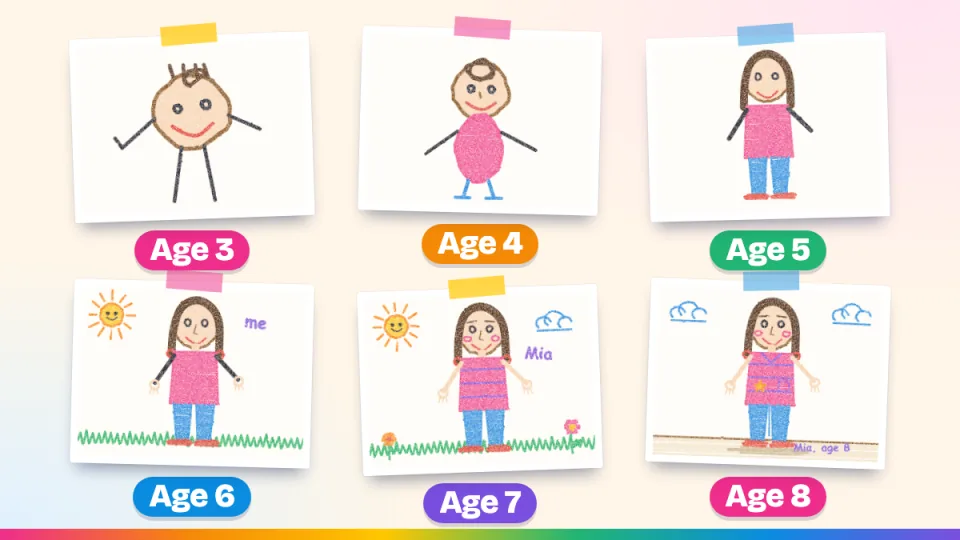
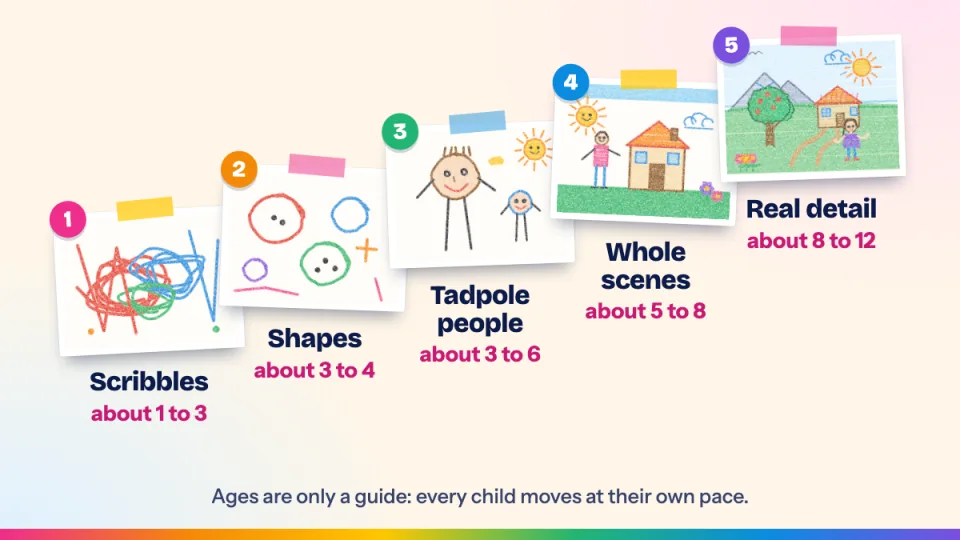
If you keep a few drawings from each year, you will see something remarkable: a child's drawing changes in a pattern. The wild scribbles turn into circles, the circles into a face with legs, the face into a whole family standing on a green line with a sun in the corner.
Researchers have described these steps for almost a century, and parents recognise them at once. This guide describes each stage in plain words, with the approximate age ranges, what is typical, and how to enjoy them. The ages are a guide, not a test. Children vary a great deal, and an early or late drawer is not "ahead" or "behind".
What are the stages of children's drawing?
Most models follow the same order. Two names come up often: Rhoda Kellogg, who studied large collections of young children's drawings, and Viktor Lowenfeld, whose book Creative and Mental Growth (1947) set out the stages teachers still use. The names and ages differ between sources, so we describe the stages in a friendly way:
| Stage | About what age | What you will see |
|---|---|---|
| 1. Scribbles | 1 to 3 | Marks and loops, first random, then controlled |
| 2. Shapes and first symbols | 3 to 4 | Circles, crosses, squares, suns and spirals |
| 3. Tadpole people and early pictures | 3 to 6 | Faces with legs, things floating on the page |
| 4. Schematic drawing | 5 to 8 | Baseline, sky, houses with doors, "X-ray" drawings |
| 5. Growing realism | 8 to 12 | Overlap, detail, shading and proportion |
Stage 1: Scribbles (about 1 to 3)
The first marks are about the movement, not the picture. A toddler waves a crayon and sees a line appear. Over a year or so, three things happen:
- Random scribbles come first: big arm movements, the crayon often leaving the page.
- Controlled scribbles follow: repeated loops, zigzags and lines the child can aim.
- Named scribbles appear around two or three: "That's Daddy", "That's a bus". The scribble has not changed, but the child now has a meaning in mind.
Keep a few of these. They are the beginning, and they look wonderful in a book.
Stage 2: Shapes and first symbols (about 3 to 4)
The child can now close a circle, and a new world opens. You will see:
- Circles, crosses, squares and suns with rays.
- Spirals and "mandala" patterns with a cross inside a circle.
- Early attempts to join shapes, such as a circle with lines for a sun.
Stage 3: Tadpole people and early pictures (about 3 to 6)
The best-loved stage. The child draws a tadpole person: a round head with legs, and perhaps arms, coming straight out of it. They are still people, and children can tell you exactly who is who.
Other features of this stage:
- Objects float on the page, with no ground or sky.
- Sizes follow importance rather than reality: Mum is huge, the dog is small.
- Colours are chosen for fun, so a green sky and a purple cat are fine.
- Bodies appear, often as a long oval or a second circle.
Stage 4: Schematic drawing (about 5 to 8)
The child now has a "recipe" for each thing: a house is a square with a triangle on top, a door and a chimney. Typical signs:
- A baseline. A green strip at the bottom, with everything standing on it.
- A sky line. A blue strip across the top, with the sun in the corner.
- "X-ray" drawings, where you can see the people inside the house or the dinner in the tummy.
- Fold-over: objects drawn upright around a road, as if the page were laid flat.
- Repeated shapes: the same tree, house and flower, which they get better at.
Stage 5: Growing realism (about 8 to 12)
Children want their drawings to look "right". They add overlap, depth, shading and proportion. Many get frustrated when something does not look the way they imagined. This is the stage when children say, "I can't draw." Warm encouragement and a good pencil help more than correction.
What is normal?
Each child moves at their own speed, and the stages overlap. Some children draw cars and animals long before people. Some prefer building to drawing. Please remember:
- A child who draws "late" is not behind.
- Fine motor skills (holding a crayon) matter a lot at the start.
- If you are worried about your child's development, speak to their teacher or health visitor, who can look at the whole picture rather than a single drawing.
Do drawings show how a child feels?
Parents often search for what colours and shapes "mean". The honest answer is that a single drawing says very little. Children choose colours they like, or those that are near, and their pictures show what they are able to draw. Listening works better: ask "Tell me about your picture", and notice what they say. If a child's drawings change a lot at the same time as their mood or behaviour changes, talk to them, and to their teacher or doctor if you are concerned.
How can you encourage a child's drawing?
- Ask open questions. "Tell me about it" beats "What is it?"
- Praise effort and detail, not how realistic it looks.
- Offer different tools: chunky crayons, felt tips, chalk, paint and big paper.
- Draw with them, and let them see you enjoy it. Don't draw their picture for them.
- Put drawings on show, and keep them. A child who sees their work valued draws more.
Keep your child's artwork safe
Free to download on iPhone and Android.
 Coming in a few days

How can you keep a record of the stages?
You do not need to keep everything, but a few pieces from each stage tell the story. A simple method:
- Date every drawing, in pencil on the back. Add your child's age and what they said about it.
- Keep one or two from each season in the box. See what to keep.
- Photograph the rest. A photo is enough for the scribbles from the same afternoon.
- Make a book at the end of the year. A book of drawings from age two to six is one of the loveliest things a family can have. See how to make a children's artwork book.
- Start a yearly self-portrait. One drawing per year in the same place shows the stages at a glance. See the yearly self-portrait project.
In Squiglet, every picture is filed under your child and sorted by date, so scrolling the gallery from the beginning to the end is the stages in order. See how it works.
Questions people ask
What are the stages of children's drawing?
A common model has five: scribbles (about 1 to 3 years), shapes and first symbols (about 3 to 4), tadpole people and early pictures (about 3 to 6), schematic drawing with a baseline and a sun (about 5 to 8) and growing realism (about 8 to 12). Children move through these at their own pace.
What is a tadpole person?
A tadpole person is a figure drawn as a round head with legs, and sometimes arms, coming straight from it. It is one of the first ways children draw people, usually around ages 3 to 5, and a sign of healthy development.
At what age should a child draw a person?
Many children draw their first recognisable person between about 3 and 4, but there is a wide range. Some children focus on animals, vehicles or patterns first. If you are worried, speak to your child's teacher or health visitor.
Do the colours a child chooses mean something?
Usually much less than people think. Children mostly pick colours they like, or whichever crayon is nearest. Don't try to analyse a single drawing; ask your child to tell you about it, and look at patterns over time.