To flatten rolled or curled kids' artwork, photograph it first, then press it between two clean sheets of acid-free tissue or baking parchment, under a stack of heavy books, for several days. Do not iron it, steam it or wet it. Felt-tip, watercolour and poster paint can run, stain or crack.
For tears and creases, the safest repair is often no repair at all. A good photo or scan keeps the picture looking whole, and the paper can rest. If you do want to mend a tear, use archival tape or paste on the back, never ordinary sticky tape.
Why should you photograph it first?
Before you flatten, press or mend anything, take a photo. Then, whatever happens, the picture is safe. A drawing that has been rolled up for years can be brittle, so the first careful unrolling carries some risk.
Our guides to photographing kids' artwork and scanning with your phone take only a few minutes to read.
How do you flatten a rolled or curled drawing?
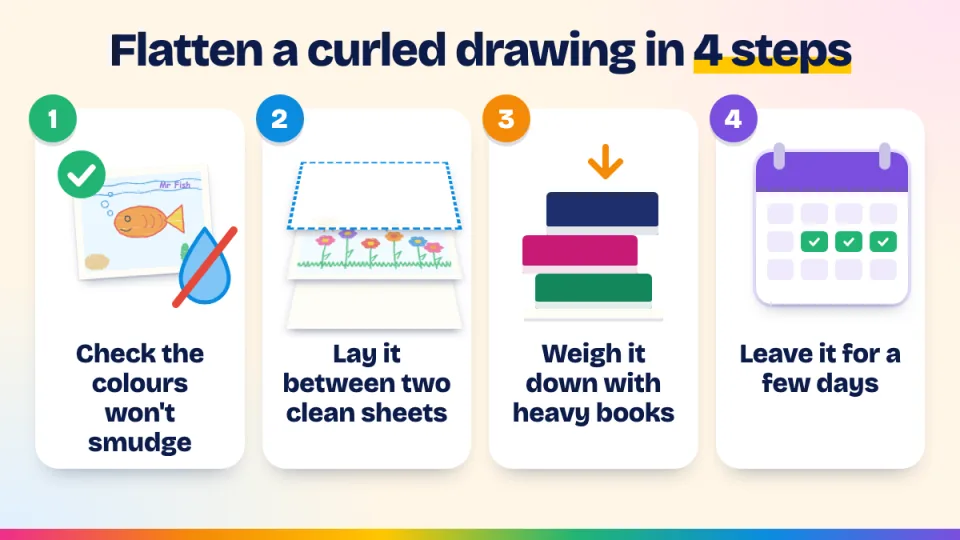
- Check the materials. Look for thick paint, glitter, glue, stickers or heavy felt-tip. Pieces with raised or sticky surfaces should not be pressed against other paper. Photograph those instead.
- Relax a tight roll. Unroll it a little at a time over a day, with your hands, never forcing it. If the paper cracks or resists, stop.
- Make a flat sandwich. On a clean, flat surface, lay a board or a large book, then a sheet of acid-free tissue or baking parchment, the drawing face up, another sheet on top and a second board.
- Add weight. Stack heavy books evenly on top, so the weight is spread and no corner gets dented.
- Wait. A few days is usually enough for a light curl. A tight roll may need a week or more. Check halfway, and swap the tissue if it looks marked.
What should you never do to flatten artwork?
| Don't | Why |
|---|---|
| Iron or steam it | Heat and moisture can make felt-tip bleed, melt crayon wax into the paper and scorch the page |
| Wet or spray it | Felt-tip, watercolour and poster paint can run, and the paper can cockle |
| Use a hairdryer | Heat curls paper further and can melt wax crayon |
| Press it with newspaper | Newsprint is acidic and can transfer ink |
| Laminate it | It cannot be undone, and it traps any moisture inside |
Can you take creases out of a drawing?
Light creases soften under weight. Deep folds rarely disappear completely, and that is fine: a crease is part of the story of how a drawing lived at the bottom of a school bag.
A photo or scan in soft light hides most creases. An app that straightens and tidies the photo helps too, which is what the Squiglet scanner does automatically.
How do you repair a torn drawing?
Think of repair as a ladder. Start at the top, and only go down if you must.
- Do nothing, and photograph it. This is often best. Keep the torn pieces flat together in a folder with a sheet of tissue.
- Archival tape, on the back. Look for tape described as archival, pH neutral or acid-free and made for paper repair. Use small strips across the tear, on the back only.
- Wheat starch paste and thin tissue. This is the traditional method used by paper conservators: a strip of thin tissue pasted across the tear from the back. It needs a steady hand and a very small amount of water, so it is not suitable for colours that run. If a piece is precious, ask a paper conservator.
Avoid ordinary sticky tape, masking tape, glue sticks, staples and rubber bands. Sticky tape turns yellow and brittle, and leaves stains that cannot be removed.
Keep your child's artwork safe
Free to download on iPhone and Android.
 Coming in a few days

If a drawing is torn into several pieces, a scan is a particularly good answer. Squiglet keeps your original photo untouched, so you can tidy up a copy while the first picture stays exactly as it was.
What about mould, stains and water damage?
Damp paper can grow mould, which can spread to anything stored beside it. Move quickly and gently:
- Isolate it. Take the piece away from other paper straight away.
- Dry it. Leave it flat in a well-ventilated room, away from direct heat and sun.
- Protect yourself. Wear gloves and a dust mask when handling it, and work outdoors if you can. If there is a lot of mould, do not handle it at all.
- Photograph it while it is dry.
- Store it separately, never with the rest of the collection. If it still smells musty or the mould comes back, scan it and let the paper go.
For stains and brown spots, leave them alone. Trying to clean them usually makes things worse, and a photograph records them as they are.
Can you trim or mount a damaged edge?
Trimming an original is rarely a good idea, but a mount can hide a ragged or creased edge without touching the paper. A mount is the card border inside a frame, and it covers a few millimetres of the drawing's edge.
If you plan to frame the piece, our guide to framing kids' artwork explains mounts and sizes. If you must trim, photograph the drawing first.
When should you stop and just scan?
Sometimes the kindest thing for a drawing is to leave it alone. Scan it and stop when:
- the paper is brittle or cracking
- paint is flaking or the surface is sticky
- there is glitter, glue or collage that would be crushed
- it is torn into many pieces
- there is mould or a musty smell
- it is too large to press flat
Once you have a good scan, you can order a print for the wall and let the fragile original rest in a box.
How can you stop it happening again?
- Store flat, not rolled. An archival box is the long-term answer. See how to store kids' artwork.
- Let painted pieces dry fully, for at least a day, before you stack anything on top.
- Keep it out of damp and sunlight, such as in a loft, garage or a window.
- Roll only as a last resort. For very large pieces, roll loosely on a wide acid-free tube, never with a rubber band, and flatten as soon as you can. Our guide to 3D art and big paintings covers the biggest pieces.
A little care at the start means you will never need most of the repairs in this guide.
Questions people ask
How do I flatten a rolled-up drawing?
Photograph it first, then let it relax by unrolling it a little at a time. Lay it between clean sheets of acid-free tissue or baking parchment and put heavy books on top for several days. Do not iron, steam or wet it. Very brittle or heavily painted pieces are better scanned than pressed.
Can I iron kids' artwork flat?
It is best not to. Heat and steam can make felt-tip pens bleed, melt crayon wax into the paper and scorch the page. Weight and time are gentler and safer. If a picture will not flatten, photograph or scan it and enjoy the digital copy instead.
What is the best way to fix a torn drawing?
Often the best fix is none: photograph it and store the pieces flat together. If you want to mend it, use archival, pH-neutral paper tape or wheat starch paste with thin tissue, on the back only. Avoid ordinary sticky tape, which yellows and leaves stains that cannot be removed.
What should I do about mould on old artwork?
Separate it from other paper straight away, let it dry in a well-ventilated room away from heat, and photograph it. Wear gloves and a dust mask when handling it, and work outdoors if you can. If it smells musty or comes back, scan it, then let the paper go.