
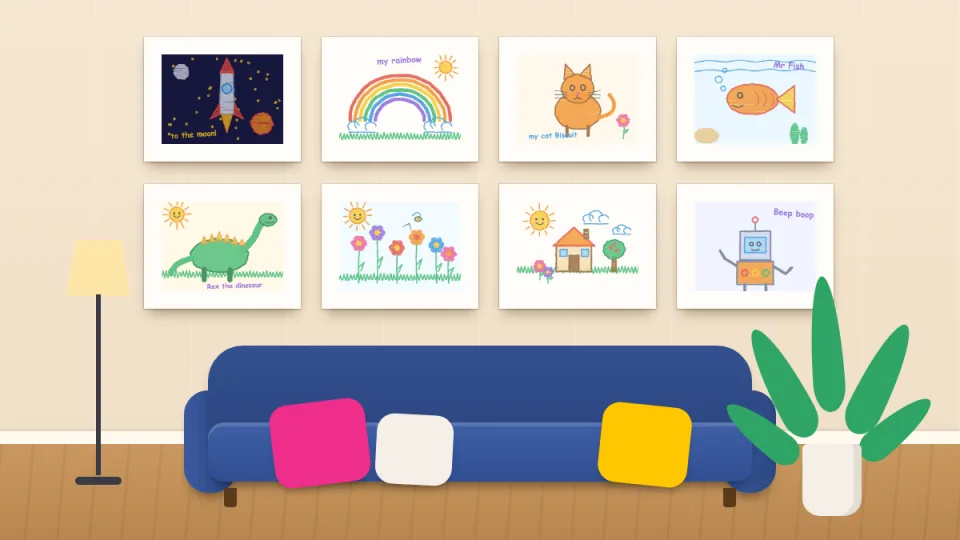
The easiest kids' art gallery wall is a grid of matching frames, 5 to 8 cm (2 to 3 in) apart, with the middle of the whole group about 145 to 150 cm (57 to 59 in) from the floor. Cut paper templates, tape them to the wall and move them around before you make a single hole.
This guide covers four layouts, how to choose frames, how to hang everything without damaging the wall, and a quick alternative if you would rather frame many drawings in one go.
Which gallery wall layout is best for kids' art?
Children's drawings come in every shape and size, which is the main challenge. These four layouts handle that in different ways.
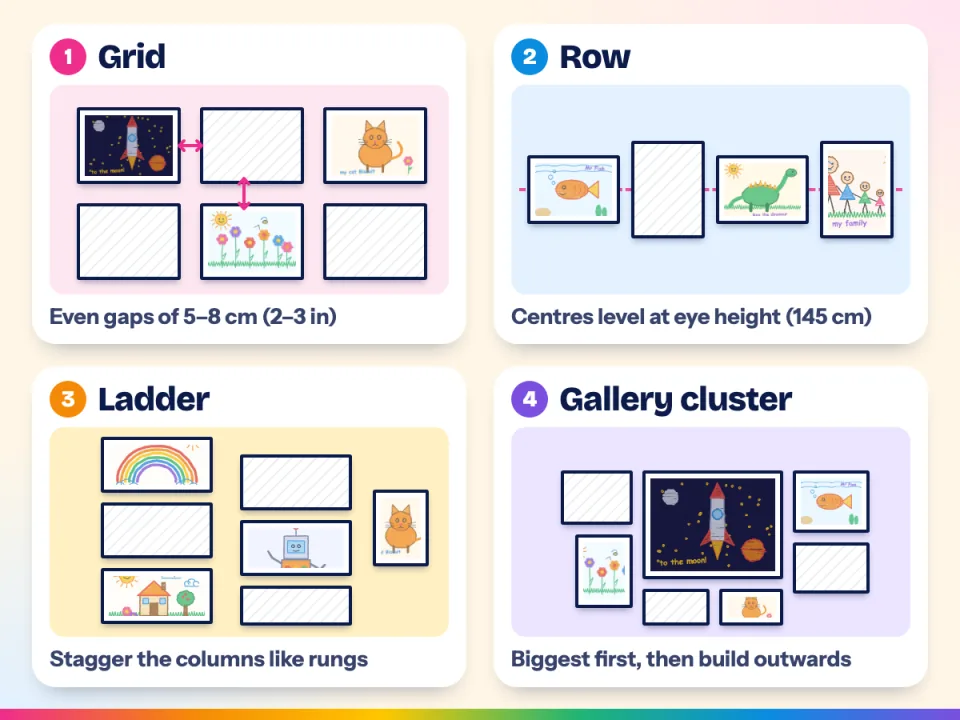
The grid
Frames of the same size in rows and columns. It is the tidiest option and the easiest to hang, because every gap is the same. It suits a collection of drawings on similar paper, such as a year of A4 pictures.
The row
A single line of frames at one height, over a bed, a desk or a shelf. A row works well in a child's room, and you can add one more frame each time a new favourite arrives.
The ladder
Frames in two staggered columns, like rungs, or stepping up a staircase wall. It adds movement without the effort of planning a free-form cluster.
The cluster
A mix of sizes grouped around one large piece. It looks the most like a gallery, and it is the most forgiving of odd-sized drawings. Start with the biggest frame near the middle and build outward.
| Layout | Best for | Effort |
|---|---|---|
| Grid | Matching sizes, a neat finish | Low |
| Row | A shelf, a desk or a bed | Low |
| Ladder | Narrow walls and staircases | Medium |
| Cluster | Mixed sizes and shapes | Higher |
How do you plan a gallery wall before you drill?
- Choose six to nine drawings. Mix portrait and landscape, and include one or two bold, colourful pieces. If the choice is hard, deciding what to keep can help.
- Photograph each one first. A photo keeps the memory safe if the original fades or goes missing. See how to photograph kids' artwork.
- Cut paper templates. Cut newspaper or brown paper to the size of each frame and write a number on each.
- Tape them to the wall. Use low-tack painter's tape. Step back, move the sheets around and take a photo of the layout you like.
- Set the height. Centre the whole arrangement at about 145 to 150 cm (57 to 59 in) from the floor, a common gallery rule of thumb. Over a sofa, keep the lowest edge about 15 to 20 cm (6 to 8 in) above it.
- Keep the gaps equal. 5 to 8 cm (2 to 3 in) is a good range. Even gaps matter more than the exact number.
- Hang from the middle outward. Start with the central frame, then work out, checking with a spirit level.
In a child's room, hang everything a little lower, so they can see their own work.
Should the frames match?
Matching frames make a mixed bag of drawings look planned. Black, white or oak all work. A wide mount (the card border inside the frame) also helps odd-sized drawings fit a standard frame and hides ragged edges. Our guide to framing kids' artwork explains mounts and sizes.
For a child's room, consider frames with acrylic glazing instead of glass. They are lighter and less likely to shatter.
How do you hang a gallery wall without drilling?
- Adhesive picture strips rated for the weight of your frames. Follow the weight limit and test in a hidden spot, because some paints can peel.
- A picture ledge or narrow shelf, which lets frames lean and be swapped in seconds.
- String and pegs for unframed drawings. It is cheap and instantly changeable.
- A magnetic or cork board for pieces you rotate often.
If you rent, strips and ledges are the gentlest options. See also 17 ways to display kids' artwork for more ideas.
Keep your child's artwork safe
Free to download on iPhone and Android.
 Coming in a few days

Whichever way you hang them, you will want a digital copy of every drawing before it goes on the wall. Squiglet files each photo under the right child and keeps the original untouched, so the paper can fade a little in the sun without losing the picture.
What is the quickest way to frame lots of drawings?
If cutting templates and drilling sounds like too much, a framed mosaic does the layout for you. With a Squiglet mosaic frame you choose 15 drawings for the 12 x 18 inch size or 24 drawings for the 18 x 24 inch size. The app arranges them in a neat grid, you swap any two by dragging one onto the other, and the print arrives in a white frame, ready to hang.
You can also mix the two approaches. Hang one large art print of the best drawing in the middle and surround it with smaller frames, or put a mosaic above a row of three.
How do you keep a gallery wall fresh?
Drawings fade in bright light, and children keep making new ones. Rotating the display solves both.
- Swap with the seasons. Take down the autumn pictures when winter starts.
- Keep a "next up" folder with the next set of favourites, ready to swap in.
- Photograph what comes down, then file the originals in a box. Our guide to storing kids' artwork shows how.
- Let your child choose. Children often take great pride in curating their own wall.
A safe wall for a child's room
Hang heavier frames away from beds and cots, fix them firmly, and choose lighter frames with acrylic glazing near where children play. Check the fixings now and then, especially after a door has been slammed or a ball has been thrown.
Start small
You do not need to plan the perfect wall. Start with three frames in a row, and add one whenever a new favourite arrives. A gallery wall that grows with your child is better than one that is finished and forgotten.
Questions people ask
How high should I hang a gallery wall?
Aim for the centre of the whole arrangement to sit about 145 to 150 cm (57 to 59 in) from the floor, which is roughly average eye level. Above a sofa, keep the lowest frames about 15 to 20 cm (6 to 8 in) above the furniture. In a child's room, hang lower so they can see their own work.
How far apart should frames be on a gallery wall?
Keep the gaps equal and fairly tight: 5 to 8 cm (2 to 3 in) suits most walls. Small gaps make a group read as one piece, while wide, uneven gaps look scattered. Cut paper templates and tape them up first, so you can check the spacing before you make any holes.
How many drawings do I need for a kids' art gallery wall?
Six to nine drawings make a good first wall: enough to look deliberate, few enough to finish in an afternoon. A framed mosaic holds 15 or 24 drawings in a single frame. You can also start with a row of three and add to it as new favourites arrive.
How do I hang kids' art without damaging the walls?
Use adhesive picture strips rated for the weight of your frames, a picture ledge that frames can lean on, or string and pegs for unframed pieces. Test a strip in a hidden spot first, because some paints peel. Choose lighter frames for children's rooms.