Here is a family tradition that costs nothing, takes ten minutes and gets better every year. On your child's birthday, hand them a sheet of paper, a pencil or crayons and a mirror, and say, "Draw yourself."
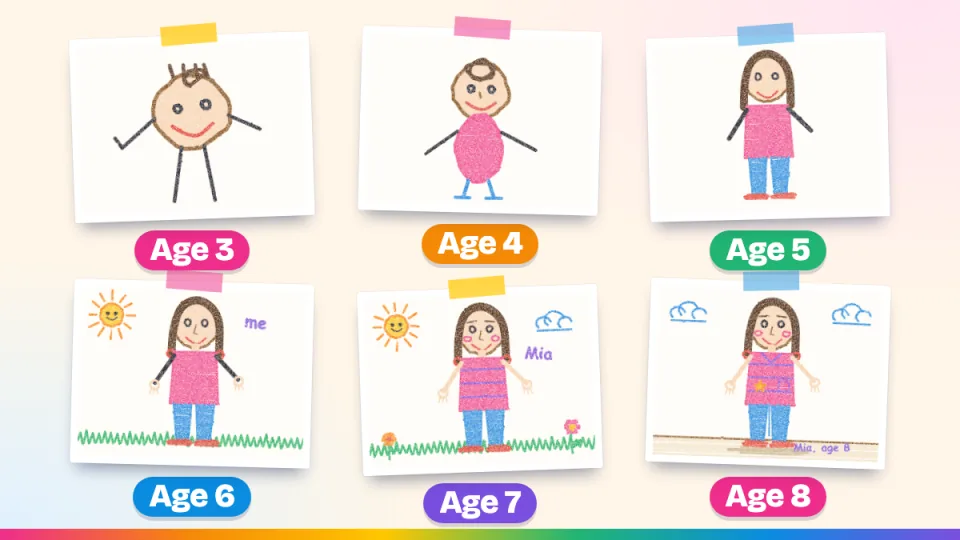
Do it every year, the same way. In five years you will have a row of drawings that show a face growing up, a hand getting steadier and a personality coming through. In fifteen years, you will have something no photograph can match.
Why a self-portrait?
- It is a record of two kinds of growth: your child's face, and their ability to draw.
- It is personal. The child decides how they see themselves, which is often more charming than any photograph.
- It is easy. There is nothing to buy, and it works at any age.
- It becomes a ritual that children look forward to, and grandparents ask about.
How do you start?
- Pick the day. A birthday is easiest to remember. Half-birthdays or the first day of school work too.
- Keep the set-up the same. Use the same size of paper (A4 is perfect), the same kind of pencil or crayon, and a mirror on the table. Do it in the same place if you can.
- Say the same words. "Draw yourself." Don't help, correct or comment on the likeness.
- Let the child sign and date it, however wobbly. If they cannot write, write it for them in pencil on the back.
- Add the interview (below) and write the answers on the back or a separate card.
- Photograph it the same day. Our photographing guide has the steps.
The ten questions to ask every year
Keep the answers in your child's own words. A year later, they are a joy to read.
- How old are you?
- What is your favourite food?
- Who is your best friend?
- What is your favourite game or toy?
- What do you want to be when you grow up?
- What makes you laugh?
- What are you good at?
- What is your favourite thing to draw?
- What is the best thing that happened this year?
- If you could have any superpower, what would it be?
What to expect, age by age
Self-portraits show the stages of drawing beautifully, although every child is different. See our guide to the stages of children's drawing for more.
| About age | What you might see |
|---|---|
| 2 to 3 | A scribble, perhaps named "me" |
| 3 to 4 | A circle with eyes, or a tadpole person |
| 4 to 5 | A head, a body, arms and legs, and maybe hair |
| 5 to 7 | A full figure on the ground, clothes, a smile |
| 8 and up | Proportion, details, a style of their own |
Make it a family project
- Draw yourselves too. A parent's self-portrait next to the child's makes children delighted and makes the series a family one.
- Siblings. Do it on the same day and keep them side by side.
- Family portrait. Ask for a drawing of the whole family in the same year. You can see who is in it, how big, and how close.
- Grandparents. Send a copy with the birthday thank-you note.
How do you keep the series together?
- Keep the originals flat in a labelled folder or an archival box, with age and date written in pencil on the back. See how to store kids' artwork.
- Photograph each one the same day, square-on, in soft light.
- Give each a clear name, such as "Self-portrait, age 5". In Squiglet you can add a title and a note, so the series is easy to find and the answers to the questions live with the picture.
- Make a book. Every few years (at 5, 10 and 18 are good times), turn the series into a book with the interview answers as captions. See photo books.
Keep your child's artwork safe
Free to download on iPhone and Android.
 Coming in a few days

What if your child doesn't want to?
Some children are shy or critical of their own drawings, especially around eight or nine, when they want things to look "right". Keep it light:
- Remind them that the point is to see how they change, not to be perfect.
- Let them choose the materials (felt tips, pencils, paint) as long as the paper size stays the same.
- Skip a year if you must, and carry on the next. A gap is part of the story.
A gift for the future
Imagine your child at eighteen, or at thirty, turning the pages of a book: a scribble at two, a tadpole at three, a girl or boy with a gap-toothed grin at six, a young person with a serious pencil at twelve. That is worth ten minutes a year. When they are grown up, you can hand it over; see what to do with grown-up children's artwork.
Questions people ask
What is a yearly self-portrait project?
Each year, usually on their birthday, a child draws a picture of themselves on the same size of paper with the same kind of pencils or crayons. You date it, add a few answers to simple questions, and keep it. After a few years, the series shows how both the child and their drawing have grown.
What age should children start?
Any age. A two-year-old's scribble labelled "me" is a perfect first entry. Most children enjoy it from about three, when they begin to draw faces.
What should I ask my child each year?
Ask the same short list every time: favourite food, best friend, favourite game, what they want to be when they grow up, and what makes them laugh. Write the answers down in their words.
How do I keep the self-portraits together?
Keep the originals in a labelled folder or box, photograph each one, and give them a clear title such as "Self-portrait, age 5". After a few years, turn the series into a book.