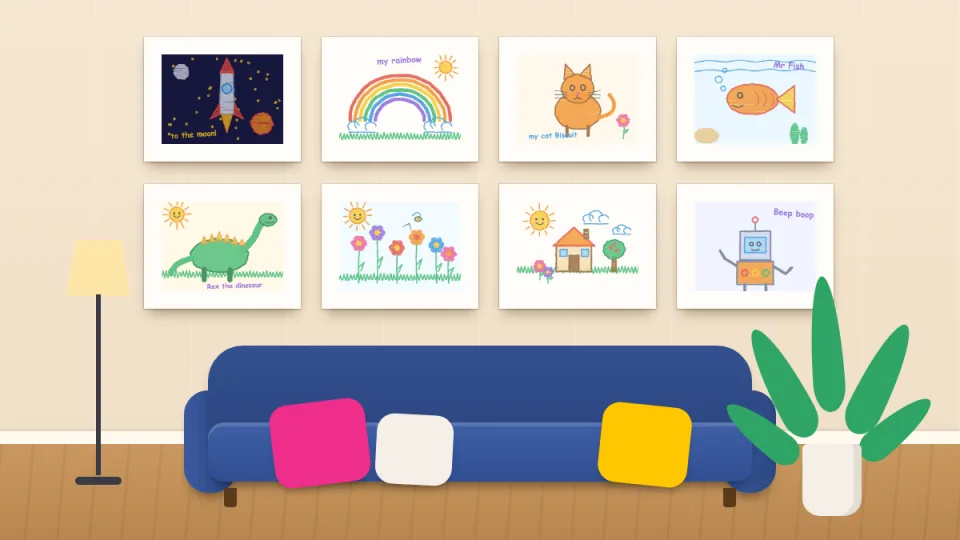

The best drawing prompts for kids are short, specific and a little silly. "Draw your pet as a superhero" gets a child started faster than "draw something", because a blank page is a big decision and a prompt turns it into a small one.
Below are more than 50 things to draw, sorted by theme, plus simple ways to use them so they last longer than one wet Sunday. They suit most children from about three or four upwards: a younger child will scribble their own version, and an older one will add a whole story.
Why do drawing prompts work?
Most children who say "I don't know what to draw" are not short of ideas. They are short of a place to begin. A prompt hands them a character, a place or a problem, and their imagination does the rest.
Prompts are a helper, not a rule. If your child is already absorbed in a drawing of their own, leave them to it.

Save the card above for later, or work through the lists below.
Drawing prompts about animals and creatures
- Your favourite animal wearing a hat.
- A dragon who is afraid of the dark.
- A cat and a dog who swap places for a day.
- The biggest fish in the sea, and what it had for lunch.
- A zoo where the animals are in charge.
- A bird building a nest from unusual things.
- An animal that does not exist yet. Give it a name.
- A dinosaur at a birthday party.
- Your pet as a superhero.
- A tiny creature that lives in your garden.
Drawing prompts about family and friends
- Your family doing your favourite thing together.
- A portrait of someone you love, with their favourite things around them.
- Yourself as a grown-up, doing your dream job.
- You and your best friend on an adventure.
- Grandma or Grandad's house.
- A self-portrait with your hair doing something surprising.
- The funniest thing that happened this week.
- A superhero with a very ordinary power.
- Your teacher as an explorer.
- A picture to cheer someone up.
Drawing prompts about places and homes
- Your dream bedroom.
- A treehouse with a secret room.
- A town where everything is upside down.
- The inside of a castle, or a cave.
- The view from your window.
- The seaside holiday you would most like to go on.
- A house on the moon.
- A map of an island you invented, with a spot marked for treasure.
- Your street as a bird sees it.
- A picnic in the strangest place you can think of.
Imagination and invention prompts
- A machine that makes cakes appear.
- A robot that helps with the tidying up.
- A vehicle that can drive on land, sea and sky.
- A monster who loves broccoli.
- A door in a tree. What is behind it?
- A potion that lets you fly. What does the bottle look like?
- The best playground in the world.
- A rocket to a planet nobody has visited.
- A creature made from three different animals.
- A pair of shoes that do something magical.
Prompts about feelings and everyday days
- What your happiest day looks like.
- How you feel right now, using only colours and shapes.
- Something you are proud of learning this year.
- Your favourite food, with a face.
- The thing you are most looking forward to.
- A dream you remember.
- A rainy day, seen from the inside.
- A thank-you picture for someone.
Prompts for seasons and celebrations
- The first snowman of winter.
- A spring garden full of flowers and minibeasts.
- A summer day at the beach or in the park.
- Autumn leaves in every colour you can find.
- Your birthday party.
- Fireworks, drawn with bright crayons on dark paper.
- A holiday decoration you would invent.
- A card for someone's special day.
How do you use drawing prompts?
- One a day. Write today's prompt on the kitchen whiteboard before breakfast and leave paper out. Ten minutes is plenty.
- A prompt jar. Write ideas on strips of paper, fold them and let your child pick one. Add some of their own ideas too.
- Mix and match. Pick one idea from the animals list and one from places for combinations you could never invent, like a dragon at the seaside.
- Let them veto. Offer three prompts and let them choose or swap. Choice keeps it fun.
- Draw alongside them. Children often relax when a grown-up is drawing too, wobbly lines and all.
- Change the materials. The same prompt in felt tips, then paint, then chalk gives three different pictures.
Which prompts suit which age?
| Age (roughly) | What tends to work |
|---|---|
| 2 to 3 | One simple word at a time: "sun", "dog", "me". Expect scribbles, and enjoy them. |
| 4 to 5 | A character plus a place: "a cat in a boat". They will often tell you the story as they draw. |
| 6 to 8 | Short stories and series: "draw the cat's day in four boxes". |
| 9 and over | Detail and design challenges: a map, a creature sheet, a comic page. |
Ages are only a rough guide, because children vary a great deal. For more on how drawing changes as children grow, see our guide to the stages of children's drawing.
Keep your child's artwork safe
Free to download on iPhone and Android.
 Coming in a few days

Prompts make a lot of drawings, quickly. An app such as Squiglet files each one under the right child, grouped by month, so a few weeks of prompts become a tidy timeline instead of a pile on the kitchen counter.
What should you do with the finished drawings?
- Write the prompt on the back. Add the child's name, their age and the date in soft pencil: "Draw your pet as a superhero. Max, 5, October." The prompt is a ready-made caption. Our guide to storing kids' artwork explains why that little note is so valuable.
- Photograph it before it goes on the fridge. The photography tips take a minute to learn, or use the scanning feature.
- Pick the keepers. Not every prompt drawing needs to be kept. Deciding what to keep is easier with a few simple questions.
- Turn a themed month into a book. Prompts make natural page titles, like "Dragons" or "Our Treehouse". See how to make a children's artwork book, or look at photo books.
- Share it with family. A grandparent's reaction to a dragon who is afraid of the dark is half the fun. A private family gallery beats posting publicly; our guide to sharing safely explains how.
How can you make up your own prompts?
The simplest recipe has three parts: a character, a place and a problem or wish. "A fox, in a lighthouse, who has lost his glasses." Ask your child to supply each part, and you will never run out.
Good prompts also ask a question ("what is behind the door?"), name a feeling, or include something to count ("seven windows"). Anything that gives a child a first line to draw is a good prompt.
A gentle tip to finish
When your child finishes, try "tell me about your drawing" instead of "what is it?". It saves a small moment of awkwardness and usually gets you the whole story.
The aim is not a good drawing. It is a habit of making things, and a stack of dated pictures you will both enjoy in ten years.
Questions people ask
What are good things for kids to draw?
Good things to draw are specific and a little playful: a favourite animal in a hat, a dream bedroom, a robot that tidies up, or the family doing something fun. Mixing a character with a place, such as a dragon at the seaside, gives even reluctant artists an easy way in.
What do I do when my child says they don't know what to draw?
Offer two or three small, specific prompts and let them choose, or pick one from a jar. Ask a question rather than giving an order: what would your pet wear to a party? If they still say no, that is fine. Leave paper and crayons within reach and try again later.
Should I draw with my child?
Yes, if they want company. Many children relax when a grown-up draws too, wobbly lines included. Try to follow their lead rather than showing them how, and ask them to tell you about their picture afterwards. If they would rather work alone, stay nearby and let them get on with it.
What should I do with all the drawings afterwards?
Write the child's name, age, date and the prompt on the back in soft pencil, photograph the ones you like and keep a small selection. A scanning app can file each picture under the right child by date, and the best drawings can become a photo book or a print on the wall.