
Every parent reaches the same point: the fridge is full, the box under the bed will not close, and a fresh drawing arrives every day. You do not need to keep it all, and you do not need to throw it all away. You need a short list of things to do with each piece.
The quickest way is to ask one question about every drawing: do I want to keep it, show it, share it, make something from it, or let it go? Below are fifteen ideas, grouped by those five answers. Most families end up using a bit of each.
How do you decide what to do with a drawing?
Start with a quick, kind sort. Make three piles: keep, photograph then release, and let go. The chart below walks through the questions to ask, one drawing at a time.
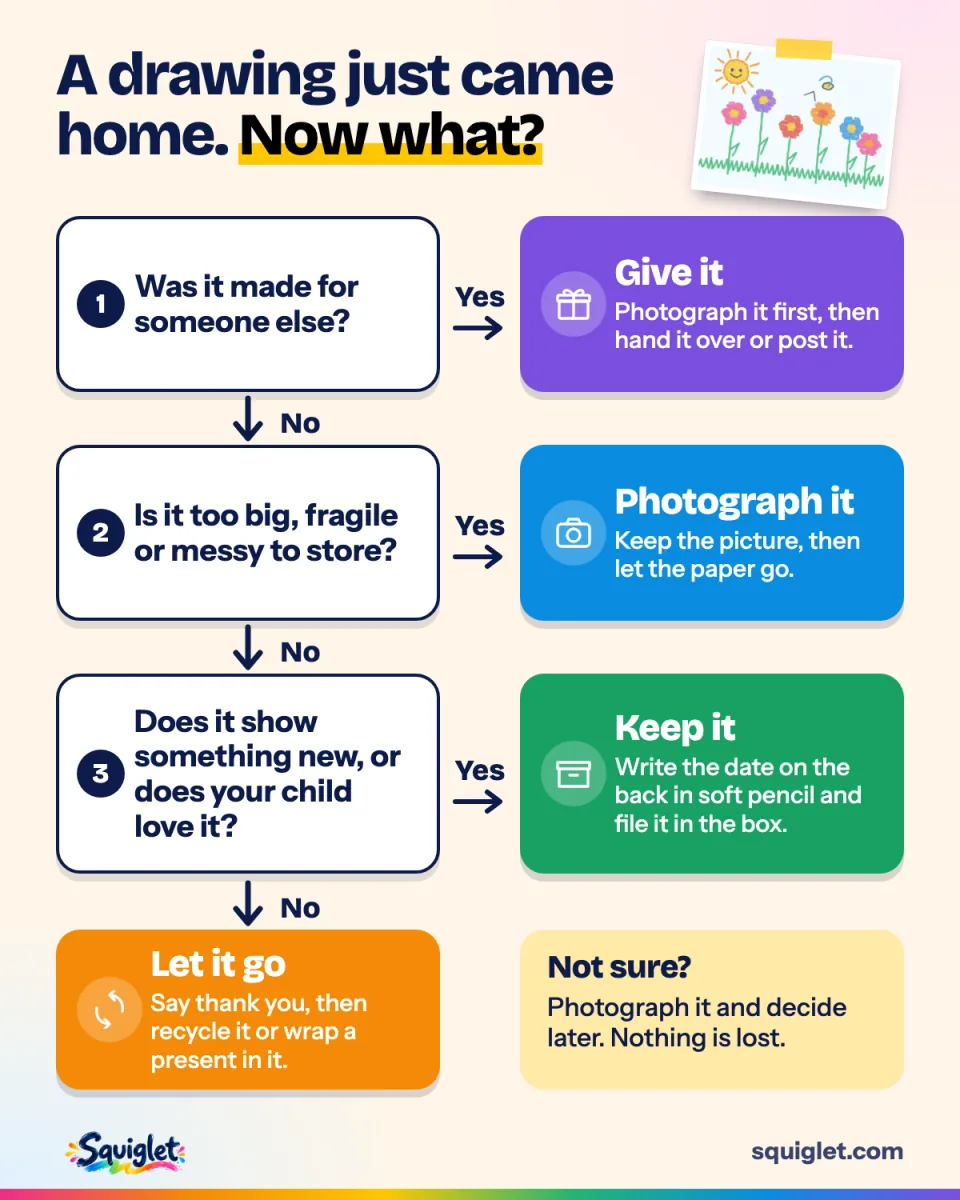
Our guide to deciding what kids' artwork to keep goes deeper, with examples of what most parents are glad they kept and a script for when your child objects.
Keep it
1. Photograph it first
Photograph every drawing before you do anything else with it. A photo takes ten seconds, and once it is safely saved you are free to display, post or recycle the paper. See how to photograph your child's artwork for the setup that gives clean, colourful pictures.
2. Give each child one box
A single flat, labelled box per child is a limit you can live with. When it is full, you choose what earns its place. Use acid-free materials for anything you want to last; our guide to storing kids' artwork covers the boxes, the tissue and the places to avoid.
3. Make a yearly book
A year of drawings in a book is storage you actually enjoy. Choose 30 to 60 pieces, add captions in your child's own words and have it printed. You can build one in the Squiglet app (see photo books), or follow our step-by-step guide to making a children's artwork book.
4. Start a "firsts" folder
The first time your child wrote their name. The first recognisable horse. A self-portrait at every age. Put these in a separate folder and they will never be lost among the rest. Try a yearly self-portrait if you want an easy tradition to start.
Show it
5. Rotate a display
A string with pegs, a corkboard or a magnetic strip keeps this month's favourites on show. When something new goes up, the old one comes down, gets photographed and goes in the box. Our 17 ways to display kids' artwork has plenty of ideas.
6. Frame the favourite
One drawing, framed with a wide mount, can hold a wall like a real piece of art. Our guide to framing kids' artwork shows how to choose the size and keep the paper safe behind the glass.
7. Build a gallery wall
Six or eight drawings in matching frames look deliberate and joyful. The hardest part is planning the layout, and a simple paper template on the wall makes it easy. Our guide to a kids' art gallery wall shows the layouts.
8. Put many drawings in one frame
If a single frame feels too precious, a framed mosaic puts 15 or 24 drawings in one white frame, laid out for you, ready to hang.
Share it
9. Share a private gallery with family
Grandparents and aunts would love to see the drawings but cannot visit the fridge. A private family gallery lets them look, and say something kind, whenever they like. Read how to share your child's artwork with family safely, or see how family sharing works in Squiglet.
10. Post a real postcard
A drawing on a real postcard, with your message on the back and a stamp, is a lovely thing to find on the doormat. You can design one in the app; see postcards.
11. Give the original to the person it was made for
If your child drew it for Grandma, it belongs to Grandma. Photograph it first so you keep the memory, then post the original.
Keep your child's artwork safe
Free to download on iPhone and Android.
 Coming in a few days

Make something from it
12. Cards and wrapping paper
A scanned drawing becomes a card, a gift tag or a sheet of wrapping paper at home or at a print shop. We list more in things to make with kids' drawings.
13. Put a favourite on a phone case
The back of your phone is the place you look most often. A printed phone case puts a favourite drawing there.
14. Turn it into a present
Grandparents, godparents and teachers treasure a gift made from a child's art far more than something from a shop. See our gift ideas for grandparents.
Let it go
15. Let it go kindly
Some drawings are lovely for a day and then have done their job. Photograph it, thank it, and recycle it. Some families let the child put it in the recycling themselves, which often feels better than a parent doing it in secret. Pieces that were fun but not keepers also make good wrapping paper, bookmarks or collage material.
A routine that keeps it under control
- Weekly: unpack the school bag, photograph anything worth remembering, put the keepers in a folder and the rest in the recycling.
- Termly: a ten-minute sort of the folder, and a rotation of the wall display.
- Yearly: choose what goes into the box, and order the book.
It is the habit that keeps the clutter from coming back, not a big clear-out once a year. Squiglet is built around it: photograph a drawing, and the app straightens it, files it under the right child and keeps the original safe, so the piles never form. See how it works on the app page.
Questions people ask
What should I do with my child's old artwork?
Sort it into three piles: keep, photograph then release, and let go. Keep a small selection in one box per child, photograph the rest, and turn the best into a book or a print so the memory lives somewhere you will actually see it.
Is it okay to throw away kids' artwork?
Yes. Nobody can keep everything, and children usually care more about making the picture than keeping it. Photograph the pieces you want to remember first, and let your child help choose, so letting go feels fair rather than secret.
How do I keep kids' artwork without it taking over the house?
Give it a limit: one flat box per child, a folder for the current school year, and a yearly clear-out. Everything else is photographed and filed digitally, where it takes no space at all.
What can I make from my child's drawings?
Popular choices are a yearly photo book, a framed print, a phone case, cards, wrapping paper and a postcard to a grandparent. Our guide to things to make from kids' drawings has more.